

What Is an AI Concierge for Hotels? A Plain-English Guide for Owners and GMs
Aug 18, 2026 · 9 min read · Pariotics, Editorial
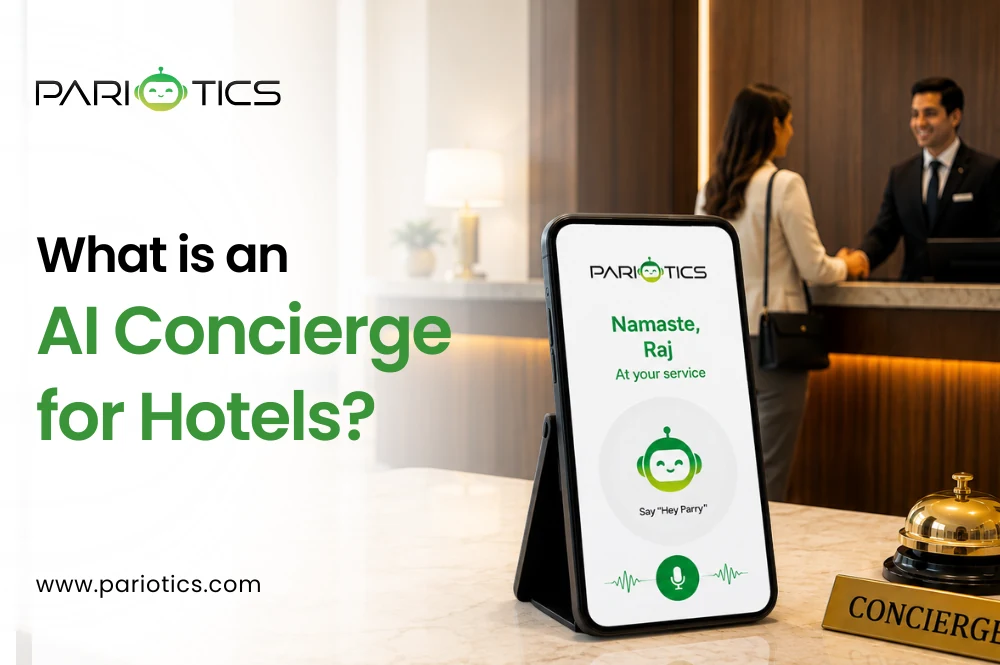
Every hotel owner has heard the pitch by now. Someone at a trade show or in a LinkedIn message tells you that an AI concierge for hotels will fix your guest experience. Then they show a chatbot that answers "what time is breakfast" and not much else.
So let's clear this up properly. This guide explains what a hotel AI concierge actually is and what it isn't, how one fits into the way your property already runs, and what to ask before you sign anything. No hype. Just the working parts.
What Is an AI Concierge in Hotels?
An AI concierge for hotels is a system that takes guest requests in plain language, understands them, and turns them into action inside your operation. A guest says "I need two more pillows" or "book me a taxi to the airport at 6." The request lands with the right team as a tracked task. Nobody has to dial zero, wait on hold, or explain the same thing twice.
It helps to rule a few things out too, because the term gets stretched.
- It's not a chatbot on your booking page. Those handle pre-arrival questions. Useful, but they do nothing once the guest is upstairs and the towel hasn't arrived.
- It's not a smart speaker you bought retail and put on the nightstand. Consumer devices need a wake-word, they don't know your menu, and they can't tell housekeeping anything.
- It's not another hotel guest app. Apps have their place, but most guests won't download one for a two-night stay. Adoption rates on guest apps stay low for a simple reason: nobody wants to install software to ask for a toothbrush.
- And it's not an IVR phone tree with a nicer voice. "Press 2 for housekeeping" is still a script, however friendly the recording sounds.
The best versions do this by voice, right in the room, in the guest's own language. That's the difference between a hotel voice assistant and a glorified FAQ page.
How AI Concierge Works in Hotels
Strip away the marketing and a proper AI voice concierge for hotels does three things. If a product can't do all three, it's a partial solution.
It listens the way guests actually talk
Guests don't speak in commands. They say "it's a bit cold in here" rather than "set temperature to 24 degrees." They say "can I get something to eat" at 11:40 p.m. without knowing whether the kitchen is open. A good hotel in-room voice assistant handles that natural phrasing, and it does so in the guest's language, not just English.
That last point matters more than most vendors admit. Think about how many guests never call the desk at all because they're not confident on the phone in a second language. A multilingual AI concierge for hotels removes that friction. The guest speaks Arabic, Hindi, German or Japanese, and the request still reaches your team in a form they can act on.
It routes the request to the person who'll do the work
This is where most "digital concierge for hotels" products quietly stop. They collect the request and send an email or a notification to a shared inbox. Then the request enters the same black hole it always did.
A real system creates a task, assigns it to housekeeping, room service, engineering or the front desk, timestamps it, and notifies the person on shift. If the task sits too long, it escalates before the guest has to ask twice. That's what turns a voice interface into a service tool.
It gives management a view of service as it happens
Ask yourself a hard question. Right now, do you know how many guest requests came in last night, how long each one took, and which ones are still open?
Most properties can't answer that, because requests live in phone calls, WhatsApp groups, radio chatter and paper notes at the desk. A proper AI guest experience platform puts every request on one dashboard. What was asked, who owns it, how long it took, and where the delays are stacking up. That's not surveillance of your team. It's the first time many owners get to see the follow-through layer at all.
Benefits of AI Concierge for Hotels
Vendors love to talk about "next-level guest experience." Owners tend to care about four things that are easier to measure.
- Review scores. Follow-through failures are what drag a solid 4.6 down toward 4.1. Not the lobby, not the linen. Catching requests reliably, especially at night, is the most direct lever most properties have on that number.
- Front-desk load. Every request that goes to the room instead of the phone is a call your desk doesn't take. That's real capacity back for the interactions that need a human, like a complaint or a special occasion.
- Shift handoffs. When requests are on the record with an owner and a timestamp, the morning shift inherits a list, not a rumour. Fewer things fall in the gap between 7 a.m. and 7:15 a.m.
- Repeat business. A guest whose small requests were handled cleanly is more likely to book direct next time. A 24/7 AI concierge for hotels doesn't create loyalty by itself, but it removes the small failures that quietly kill it.
We'd caution against any vendor who quotes you a precise revenue uplift before they've seen your property. The honest answer is that results depend on your baseline, your staffing, and how well the system is integrated. Ask for a pilot, not a promise.
AI in Hotel Guest Services
Guest services has always meant one thing at its core: someone asks for something, and someone else gets it done. What's changed is how much of that exchange now happens without a phone call.
AI in hotel guest services covers the full range of a stay, not just the front desk. Room controls, wake-up calls, dining questions, transport bookings, maintenance issues, and simple information like pool hours or Wi-Fi passwords all move through the same channel. The guest doesn't need to know which department handles what. They just ask, and the system sorts out where it goes.
The shift that matters most is speed of first contact. A guest who has to find a phone, dial an extension, and explain themselves is a guest who often gives up. Voice removes that step entirely, which is why AI has moved from a back-office scheduling tool into the guest-facing side of the room itself.
Hotel Automation with AI Concierge
Automation in this context doesn't mean replacing staff. It means removing the manual relay work that sits between a guest's request and a staff member's action.
Before automation, a request typically passes through several hands: guest to desk, desk to radio or WhatsApp, radio to the right department, department back to desk to confirm. Each handoff is a place things get missed, especially overnight or during a rush.
Hotel automation with AI concierge collapses that chain. The request goes straight into a task queue with an owner and a clock running. Nothing sits in a shared inbox waiting to be noticed. Nothing depends on someone remembering to mention it at the next shift change. The automation isn't guest-facing flash — it's the plumbing that makes sure a "yes, right away" from the front desk actually turns into a completed task.
Examples of AI Concierge in Hospitality
Picture a 120-room property on a Tuesday. It's 11:30 p.m. Two people are on the night desk. One is handling a late check-in, the other is on the phone with a guest who can't get the Wi-Fi working.
Room 412 wants extra towels. Room 208 needs a 5:30 a.m. wake-up call and a taxi. Room 316 wants to know if the pool is open in the morning.
Without an AI concierge, all three of those become phone calls to a desk that's already busy. Two get scribbled on a pad. One doesn't get called in at all because the guest gives up after four rings. Tomorrow's shift never sees the scribbles. The wake-up call is missed. Somewhere in the next fortnight, one of these shows up as a three-star review with the words "small things."
With one, all three guests speak to the room. Towels become a housekeeping task with a timestamp. The wake-up call and taxi are logged and confirmed. The pool question is answered instantly. Your night team handles the check-in and the Wi-Fi issue without dropping anything else. In the morning, the GM can see all of it happened, and how long each took.
A second example: a guest who speaks limited English asks, in their own language, for the room to be a little warmer and for extra pillows. No fumbling with a phone translation app, no call to a desk that may not have a fluent speaker on shift. The request lands correctly the first time.
Nothing dramatic in either case. That's rather the point.
AI Chatbot vs Human Concierge Hotel
This comparison gets framed as a choice, but it isn't really one. A booking-page chatbot, an in-room voice concierge, and a human concierge or front-desk team solve different problems, and most properties need more than one.
A chatbot is good at pre-arrival questions: room types, cancellation policy, parking. It's built for browsing, not for a guest standing in a room at midnight who needs something now.
A human concierge is irreplaceable for judgment calls: a restaurant recommendation tailored to a guest's taste, smoothing over a complaint, handling anything unusual or emotionally sensitive. No AI system should be positioned to replace that.
An AI concierge for hotels sits between the two. It handles the high-volume, repetitive, structured requests — extra towels, wake-up calls, temperature, transport bookings — so that human staff spend their time on the interactions that actually need a person. Framed as competition, this is the wrong question. Framed as division of labour, it's straightforward: let the system catch the volume, let your people handle the moments that matter.
AI Hotel Customer Service Trends
A few patterns are showing up across the industry worth naming plainly.
- Staffing pressure isn't going away. Many properties are running service on leaner night teams than they'd like, and that's not reversing. Systems that catch requests without adding headcount are becoming less of a nice-to-have.
- Guests expect self-service, but not at the cost of speed. People are comfortable asking for things without a human on the other end, as long as the response is fast and doesn't require downloading anything.
- Multilingual service is a growing differentiator. International travel has recovered past pre-pandemic levels in many markets, and guests increasingly expect service in their own language as a baseline, not a premium extra.
- Review platforms are getting more granular. Guests now call out specific failures ("asked twice for towels") rather than general dissatisfaction, which makes follow-through failures more visible and more damaging than they used to be.
- Voice is re-entering the room. After a wave of guest-app investment that saw mixed adoption, more properties are moving back toward voice and touch as the lower-friction default, with apps reserved for guests who specifically want one.
Future of AI Concierge in Hotels
The next stage of this technology is less about new gadgets and more about memory and integration.
Preference memory across stays — pillow type, room temperature, dietary notes — is what starts to make a returning guest's second visit feel personal without extra effort from staff. That only works if the system remembers the guest, not just the room.
Deeper integration with property management and CRM systems will matter more too. A concierge system that can see a guest is checking out at 11 and already has a car booked is more useful than one working in isolation from the rest of the property's software.
Expect the category to expand beyond hospitality as well. The same voice-and-touch, request-to-task model applies to patient requests in healthcare, resident requests in senior living, and citizen requests in government services. Hotels are simply where this pattern is proving out first, because guest expectations and staffing pressure are both acute there.
Digital Concierge for Hotels Explained
Pulled together, a digital concierge for hotels is best understood as three layers working together: a way for guests to ask for something without friction (voice and touch, no app, no wake-word), a routing layer that turns that ask into a tracked task for the right team, and a management view that shows what's happening across the property in real time.
Any product that only does the first layer is a gadget. A product that does all three is an operations tool.
Questions to Ask Before You Buy
If you're evaluating a hotel guest experience platform of any kind, these questions separate real operations tools from demos.
- Does it work without a wake-word? Guests won't remember to say a brand name before every request. Natural, no-wake-word interaction is table stakes for in-room use.
- How many languages, and how well? Ask to test with a native speaker of a language your guests actually use, not a scripted phrase in the demo.
- Where does the request go? Push for specifics. Which department, which device, what happens if nobody accepts it in ten minutes?
- Can we see the operations side? Any serious system will show you a live dashboard of requests, response times and departmental workload. If they can't, they've built a guest gadget, not a service platform.
- Does it remember returning guests? Preference memory across stays is what makes a second visit feel personal without extra work for staff.
- What does the staff side look like? The team receiving tasks needs something simple that fits how they already work. If it adds steps for housekeeping, adoption will die within a month.
- How is guest data handled? Ask about where recordings and requests are stored, who can access them, and how they're deleted. You'll want clear answers before your legal team asks.
Where Pariotics Fits
We built Pariotics as an in-room AI concierge for hotels because we kept seeing the same gap. Hotels had beautiful properties and hard-working teams, and requests were still dying between shifts. Guests speak, or tap the screen, in more than 20 languages, with no app and no wake-word. Every request becomes a live, tracked task for the right team, and management sees the whole picture on one dashboard.
It's practical AI, built for hotel operations rather than for headlines. Voice that Serves!
We're currently opening conversations with a first group of hotel partners ahead of public launch. If you run operations or guest experience at a property and want to see how this would work in your rooms, book a demo and we'll show you.
See Pariotics in action
Book a demo or talk to an expert. We'll walk through how an in-room AI concierge would work in your rooms.
Book a demoFrequently asked questions
- Is an AI concierge the same as a hotel guest app?
- No. A guest app requires a download and lives on the guest's phone. An in-room AI concierge is already in the room and needs nothing from the guest but their voice or a tap. Some hotels run both, but the in-room device is what captures the late-night requests that apps miss.
- Will guests actually use a hotel voice assistant?
- In our experience the deciding factor is effort. If the device needs no setup, no wake-word and no instructions, guests use it the way they'd use a light switch. If it needs onboarding, they don't.
- Does it replace front-desk staff?
- No. It takes the routine requests off the phone so your people can focus on the interactions that need judgment and warmth. The teams we speak with see it as capacity, not replacement.
- Can it work in a small independent hotel, or only in chains?
- Both. Smaller properties often benefit most, because a night desk of one or two people feels the phone load hardest. Larger groups value the consistency and the reporting across sites.
- How does it handle a language the system doesn't support well?
- A good platform will tell you its supported languages honestly and let you test them. Ask for the list, and test it with real guests during a pilot.
- What's the difference between an AI concierge and a virtual concierge for hotels?
- The terms overlap. "Virtual concierge" is often used for chat or web-based tools. When we say AI concierge, we mean a system that understands natural speech, routes requests into your operation, and reports on the outcome.